Why Use Stainless Steel Powder for Manufacturing?
Stainless Steel Powder gives manufacturers a route to shape corrosion-resistant alloys into fine, controlled forms. It supports metal injection molding, powder metallurgy, and additive manufacturing. Each process uses powder differently. Particle size, chemistry, flow, and density can affect filling, bonding, and the finished part. A small variation may show up as a weak edge or rough surface. Details matter.
The market context is substantial, though it should not be mistaken for powder demand. The World Stainless Association’s Stainless Steel in Figures 2024 reports global stainless steel production of 58.4 million tonnes in 2023. Separately, Wohlers Report 2024 estimates the additive manufacturing industry reached US$20.0 billion in 2023, across materials, equipment, and services. These figures show broad industrial scale, not a direct measure of stainless powder sales. That distinction matters.
Why use it, then? Stainless steel powder can enable complex geometries, near-net-shape production, and efficient material use, particularly where machining solid stock would create substantial scrap. It also offers access to established alloy families, including grades selected for strength or corrosion resistance. Yet powder is not automatically the better choice. Feedstock consistency, process controls, post-processing, and application requirements all influence cost and performance. A practical decision starts with the part, not the trend. This guide examines the material’s manufacturing advantages, limitations, and selection factors, while keeping claims tied to process realities and published industry data.
What Stainless Steel Powder Is and How It Is Made
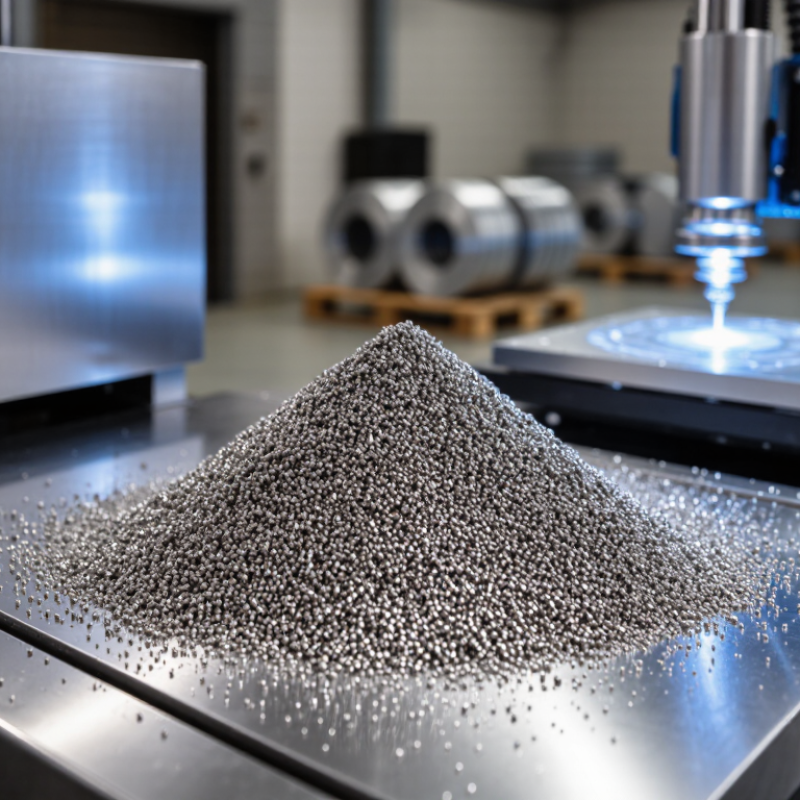
Stainless steel powder consists of small metal particles containing iron, chromium, and, depending on the grade, elements such as nickel or molybdenum. Chromium helps form a thin protective oxide layer on the steel’s surface. The powder may be spherical, irregular, or porous. Its shape and size affect how it flows, packs, and bonds during manufacturing.
One common production method is atomization. Molten stainless steel flows through a nozzle and breaks into droplets when struck by high-pressure gas or water. The droplets cool and solidify into powder. Gas atomization often produces rounder particles, while water atomization commonly creates more irregular shapes. The exact result depends on melt temperature, nozzle design, and cooling conditions. Small differences matter. Producers then screen the powder into size ranges and check its chemistry, particle distribution, and flow behavior.
Other routes include mechanical grinding and chemical reduction, though they suit different materials and applications. Each method brings trade-offs in particle shape, cost, and consistency. For example, a narrow size range can help create a more even powder bed, but it does not guarantee a flawless part. That is easy to overlook. Moisture, storage, and handling can also change powder behavior, so manufacturers typically test the material under conditions close to the intended process.
Why Use Stainless Steel Powder for Manufacturing?
Typical Alloy Composition Ranges in Stainless Steel Grades (weight %)
Stainless steel powder consists of fine metal particles, commonly made by atomizing molten alloy and then sieving the powder to selected sizes. These representative 304L and 316L chemistry ranges show how alloy content distinguishes the grades; actual powder specifications may vary.
Composition ranges are representative of ASTM A240/A240M grade limits. Molybdenum is not specified as an intentional alloying range for 304L.
How Stainless Steel Powder Supports Manufacturing Processes
Stainless steel powder supports manufacturing by giving processes a controlled feedstock that can be spread, compacted, or melted into complex shapes. In laser powder bed fusion, a thin powder layer is fused section by section, allowing channels and lightweight brackets that are difficult to machine from solid stock. Particle size distribution and flowability affect how evenly each layer spreads. Small details matter. Poor flow can leave thin spots, while excess heat may distort parts or change their microstructure.
Powder quality also matters in press-and-sinter production, where consistent particles help create uniform density before furnace sintering. ASTM International’s guide F3049 outlines methods for characterizing metal powders used in additive manufacturing. The Wohlers Report 2024 estimated the global additive manufacturing industry reached $20.035 billion in 2023, up 11.1% from 2022; this is industry-wide, not stainless-steel-powder sales. The International Stainless Steel Forum reported 58.4 million tonnes of crude stainless steel production in 2023, a 4.6% annual increase. That figure covers all stainless steel, not powder demand. In practice, manufacturers still need to screen reused powder and monitor oxygen and moisture. Reuse can reduce waste, but it is not automatically a saving if properties drift.
Why Use Stainless Steel Powder for Manufacturing? — How Stainless Steel Powder Supports Manufacturing Processes | Manufacturing Process | How the Powder Supports the Process | Typical Advantages | Important Considerations |
| Metal Additive Manufacturing | Powder-bed processes spread thin layers of metal powder and selectively fuse regions to build a part layer by layer. | Enables complex geometries, internal channels, and consolidated components that can be difficult to produce by conventional machining. | Powder size distribution, flowability, cleanliness, and alloy suitability must match the specific machine and process. Parts may require support removal and post-processing. |
| Metal Injection Molding (MIM) | Fine stainless steel powder is mixed with a binder, molded into a shaped part, then debound and sintered. | Supports high-volume production of small, detailed components with shapes that can be challenging to machine economically. | Debinding and sintering cause dimensional shrinkage, so tooling and process settings must account for it. Part size and geometry are subject to process limits. |
| Press-and-Sinter Powder Metallurgy | Powder is compacted in a die and heated below the alloy’s melting point so particles bond through sintering. | Can produce repeatable near-net-shape parts and reduce material waste for suitable component designs. | Density and properties can vary with powder characteristics and compaction conditions. The process is best suited to geometries that can be pressed and ejected from a die. |
| Hot Isostatic Pressing (HIP) | Metal powder is sealed in a container and consolidated using high temperature and isostatic gas pressure. | Can create dense, near-net-shape components and is also used to densify some powder-based or additively manufactured parts. | Requires specialized equipment and a suitable containment and process design. The resulting properties depend on the alloy and processing cycle. |
| Powder Production and Handling | Gas atomization commonly produces more spherical particles, while water atomization commonly produces more irregular particles. | Particle shape and size can be selected to support the flow, packing, or compaction needs of a manufacturing route. | Powders should be handled and stored according to safety guidance and supplier specifications. Fine metal powders may present inhalation, contamination, or combustible-dust hazards. |
| Material Performance | Stainless steel powder provides a route to manufacture parts from stainless steel alloy compositions. | Depending on the selected grade and final processing, parts can combine mechanical performance with corrosion resistance suited to particular environments. | Corrosion resistance is determined by alloy composition, part condition, surface finish, and service environment—not by the powder form alone. Grade selection and validation are essential. |
Key Properties That Make Stainless Steel Powder Valuable
Stainless steel powder combines corrosion resistance with the flexibility to form detailed parts. Chromium in the alloy helps create a thin protective surface layer when exposed to oxygen. That layer can limit rusting in damp or mildly corrosive conditions. It is not a guarantee of immunity; salt, chemicals, and poor maintenance can still cause damage.
Powder characteristics matter too. Particle size and shape affect how material flows, packs, and bonds during processing. Fine particles can fill small spaces, but they may flow less consistently. Spherical particles often move smoothly through manufacturing equipment. Angular particles can pack differently. Small details matter. In practice, the best choice depends on the process and the part’s geometry.
The powder can be used in processes such as metal injection molding, sintering, and additive manufacturing. Its alloy composition influences strength, heat resistance, and corrosion performance, while processing conditions affect density and porosity. A component may look solid but still contain internal voids that reduce durability. This is easy to overlook. Testing sample parts and checking powder specifications can help manufacturers judge whether a grade suits the intended application. I would not treat one powder as universally better; performance depends on both material selection and careful process control.
Manufacturing Benefits of Using Stainless Steel Powder
Stainless steel powder lets manufacturers shape metal close to its final dimensions. Pressing and sintering, metal injection molding, and additive manufacturing can produce parts with complex channels, thin walls, or repeated features. Less cutting can mean less scrap. The European Powder Metallurgy Association reports that powder metallurgy can achieve material utilization rates of up to 97%. Actual results depend on the part design and production route.
Consistency matters. A controlled powder blend can help maintain alloy composition across production batches, while particle size affects flow, packing, and final density. For example, a small variation in powder flow may change how evenly a die fills. That can affect dimensions. The Wohlers Report 2024 estimates that the global additive manufacturing industry reached $20 billion in 2023, showing expanding industrial use, though growth alone does not prove that powder suits every component.
There are trade-offs. Stainless steel powder requires careful storage and handling to limit moisture pickup and contamination. Parts may also need post-processing, such as heat treatment or surface finishing, to meet strength and corrosion requirements. Powder is not magic. Engineers should test the finished component under its real operating conditions, especially when porosity, surface roughness, or fatigue life matters.
Common Applications and Material Selection Factors
Stainless steel powder is used in additive manufacturing, metal injection molding, and surface-coating processes. Each method needs powder with suitable particle size and flow. In laser powder bed fusion, consistent particles help spread a thin, even layer across the build plate. Small parts with internal channels can be difficult to inspect, so powder cleanliness and process control matter.
Applications shape the grade choice. 316L is often selected for components exposed to moisture or mild chemicals, such as pump parts and food-processing fittings. 17-4 PH can suit parts that need higher strength after heat treatment, including tooling and mechanical components. Metal injection molding supports compact, detailed parts, while thermal spraying uses powder to create protective surfaces. The process changes the answer.
Check chemistry, particle-size range, shape, oxygen content, and supplier test data before purchasing. Spherical powder may flow well in some additive systems, but it can cost more and may not suit every process. A powder that handles smoothly can still create defects if its grade or size distribution is wrong. That trade-off is easy to underestimate. Trial builds and measured part performance often reveal issues that a specification sheet misses.