What Are the Top Types of Wine Refrigerators?
A bottle resting on a kitchen counter faces changing room temperatures, sunlight, and everyday vibration. A Wine Refrigerator helps control those conditions, but the right design depends on where it will sit and how many bottles it must hold. Some homes need a compact countertop unit. Others need a built-in model beneath a counter or a freestanding cabinet with room for a growing collection.
Industry research offers useful context, with limits. Grand View Research’s Wine Cooler Market report examines the category by product type and application, reflecting a market shaped by different household and commercial needs. Such reports describe market segments; they do not tell every buyer which appliance will perform best in a particular room. Wine educator and author Karen MacNeil has called wine “a living, breathing thing.” That reminder makes stable storage more than a question of appearance.
The details matter. A dual-zone refrigerator can keep reds and whites at different settings, while a single-zone model suits bottles stored for similar purposes. Built-in units require suitable ventilation, and freestanding cabinets need adequate clearance. Capacity labels can also mislead: bottle shapes vary, and a full shelf may hold fewer bottles than expected. Small differences count.
This guide compares the top types of wine refrigerators by installation style, temperature control, and practical capacity. It also considers where each type fits—and where it may disappoint. A quiet appliance is not automatically the right one. The best choice balances room layout, collection size, and the temperatures you actually need.
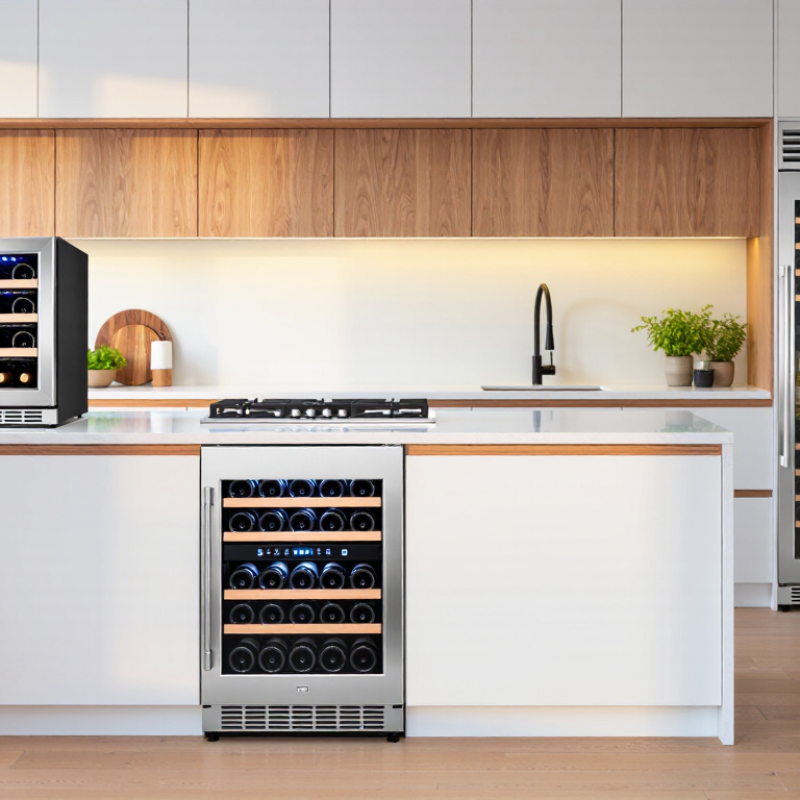
Main Categories of Wine Refrigerators
Wine refrigerators are commonly grouped by installation style. Freestanding models can sit beside a counter or in a utility room, but they need open space around their vents. A built-in unit fits beneath a counter and is designed to release heat from the front. Measure the opening carefully; a small sizing mistake can leave an awkward gap. Space matters.
Another useful category is temperature-zone design. Single-zone refrigerators keep the cabinet at one consistent setting, which suits a collection stored for similar serving or aging conditions. Dual-zone models provide separate areas, often with one section set cooler for white wines and another slightly warmer for reds. Check the usable shelf layout, too. Tall bottles may not fit neatly, even when the advertised capacity sounds generous.
Cooling systems also distinguish models. Compressor units generally handle warmer rooms and larger collections well, though they may produce some vibration or noise. Thermoelectric units can run quietly, but their performance may be less reliable in a hot space. Neither type is automatically best. Consider where the refrigerator will stand, how often the door will open, and whether quiet operation matters more than rapid cooling. The answer is sometimes less tidy than a product chart suggests.
Wine Refrigerators by Cooling Technology
Wine refrigerators mainly use compressor or thermoelectric cooling. Compressor models work much like household refrigerators: refrigerant carries heat away, while a thermostat manages temperature. They usually suit larger collections and warmer rooms, where steady cooling matters more than near-silent operation. You may hear a brief hum or feel slight vibration when the compressor starts. Check that the unit stands level and has the clearance its manual specifies.
Thermoelectric models use an electric current to move heat, rather than a compressor. They are often quieter and have fewer moving parts. Quiet matters. Their cooling ability, however, depends more on the room around them. In a sunlit kitchen or during a hot spell, a small thermoelectric unit may struggle to hold its set temperature. That detail is easy to overlook when shopping. Look at the room’s usual temperature, the number of bottles, and the unit’s stated operating range before choosing. Some designs combine cooling approaches, but labels alone do not tell the whole story; measured temperature stability and sensible placement matter more. The trade-off is not perfectly neat: a quiet cabinet may need a cooler room, while a compressor model can be more forgiving.
Top Types of Wine Refrigerators by Cooling Technology
A comparison of the core components used in compressor-based and thermoelectric wine refrigerators.
Bars indicate whether each technology uses the listed component: 1 = yes, 0 = no. Compressor refrigerators use a compressor and refrigerant loop; thermoelectric models use a solid-state Peltier module.
Single-Zone and Dual-Zone Wine Refrigerators
Single-zone and dual-zone wine refrigerators solve different storage problems. A single-zone model keeps the entire cabinet at one set temperature. It suits a collection focused on one wine style or bottles intended for longer-term storage. Shelves stay consistent, and controls are usually straightforward. Simple, but limiting.
A dual-zone refrigerator has two separately controlled compartments. You can keep whites cooler for serving and reds at a different temperature, with a divider helping reduce temperature transfer. This is useful when you open both styles regularly. Check the manual for each zone’s temperature range; some models offer limited adjustment. More control, more trade-offs.
Capacity matters, too. In a dual-zone unit, the smaller compartment may fill quickly, especially if its shelves hold fewer bottles than the advertised total suggests. Bottle shapes vary, and wider bottles can crowd a shelf. Measure your available space and consider how you actually buy and serve wine. If you mostly store one type, two zones may add complexity without much benefit. If your habits change, that choice can feel less obvious than it looked in the showroom.
Wine Refrigerators by Capacity and Storage Needs
Wine refrigerators are easiest to choose by matching bottle capacity to your actual buying habits. A compact unit holding about 6–18 bottles can suit an apartment, a small dining area, or a few bottles kept ready for guests. Measure twice. A medium cabinet, often listed around 20–50 bottles, offers room for a growing collection without taking over a room. Larger models can hold 50 bottles or more, but need enough floor space and a suitable location.
Check how capacity is measured. Manufacturers may count standard Bordeaux-style bottles, while wider sparkling bottles can take up extra shelf space. Capacity labels can flatter reality a little. If you buy mixed shapes, look for adjustable shelves and leave room to slide bottles out without disturbing others. That matters.
Storage needs also determine whether a single-zone or dual-zone refrigerator makes sense. A single-zone model keeps the cabinet at one setting, which may work well for storing similar wines together. Dual-zone models offer separate temperature areas, useful when you want some bottles chilled for serving and others stored at a different setting. For a built-in installation, check the required ventilation clearance; a freestanding cabinet may offer more flexibility in placement. Think about the bottles you reach for most, not just the collection you hope to own.