





Top RF Amplifier Manufacturers in China?

Choosing a top RF Amplifier manufacturer in China takes more than comparing catalog power ratings. Buyers should examine frequency coverage, gain flatness, noise figure, linearity, efficiency, and thermal performance. Those specifications shape real results. A compact module may fit a crowded communications enclosure, while a high-power unit may need careful cooling and installation planning.

Steve C. Cripps is a recognized authority on RF power-amplifier design. As a paraphrase of the principles in his published engineering work: “A successful RF power amplifier balances output power, efficiency, linearity, bandwidth, and thermal limits.” Treat this as a summary, not a verbatim quotation. That distinction matters. A credible supplier should provide traceable test data, clear operating limits, and practical support—not just polished marketing claims.

This overview can help readers compare Chinese manufacturers by product range, engineering capability, customization, quality controls, and after-sales service. Look for evidence such as measured performance across the specified band, realistic operating conditions, and consistent documentation. Ask how prototypes are tested and how production units are checked. Details matter. A supplier’s answer may reveal more than its headline specification. Even strong manufacturers have trade-offs; availability, lead times, and support can vary by product and project. No ranking replaces direct verification. Use the comparison as a starting point, then match each RF Amplifier to the actual system requirements.

Top RF Amplifier Manufacturers in China?

Understanding RF Amplifiers and Their Applications

An RF amplifier raises radio-frequency signals so they can travel through a transmitter chain or be detected more reliably by a receiver. Its role depends on its position: a low-noise stage preserves faint incoming signals, while a power stage drives an antenna. These circuits support cellular networks, Wi-Fi equipment, satellite links, radar, and laboratory test systems. Small component, big job.

The Ericsson Mobility Report, June 2024, forecasts average mobile data traffic per smartphone rising from about 21 GB per month in 2024 to 56 GB by 2030. That growth puts pressure on network capacity and efficient radio hardware. Amplifier design balances output power, linearity, bandwidth, noise, and energy use; improving one can compromise another. A compact module may also heat up quickly, especially in a sealed outdoor radio unit. Heat is real.

The GSMA’s Mobile Economy 2024 report estimates 5.6 billion unique mobile subscribers in 2023, around 69% of the global population. More connected devices mean RF amplifiers must work across varied frequencies and signal conditions. In practice, engineers check gain, impedance matching, and thermal performance in the intended system, not just on a datasheet. I would treat any single benchmark cautiously: antenna placement, cabling, and local interference can change measured results.

Top RF Amplifier Manufacturers in China? - Understanding RF Amplifiers and Their Applications

RF amplifier categories and representative performance ranges. Values vary by design, frequency, operating conditions, and test method; they are indicative rather than guaranteed specifications.

RF Amplifier Category Representative Frequency Range Typical Gain Typical Output Power Key Performance Considerations Common Applications
Low-Noise Amplifier (LNA) VHF through microwave bands; commonly designed for a specific band from tens of MHz to several GHz About 10–30 dB Often around −10 to +20 dBm at the 1 dB compression point Low noise figure, input matching, stability, and adequate linearity for the expected signal level Receiver front ends, satellite navigation, radio astronomy, radar, and wireless infrastructure
RF Driver Amplifier Band-specific designs spanning HF, VHF, UHF, and microwave frequencies About 10–25 dB Often around +20 to +33 dBm at the 1 dB compression point Gain flatness, linearity, and the ability to drive a final power amplifier without excessive distortion Transmitter chains, test equipment, communication systems, and radar transmitters
RF Power Amplifier (PA) Commonly designed for a defined operating band; applications include sub-6 GHz cellular and broadcast bands About 10–30 dB, depending on output level and design Ranges from below 1 W to tens of watts or more in many system designs Output power, efficiency, heat dissipation, bandwidth, and linearity; modulation schemes may require linearization Cellular base stations, two-way radios, broadcasting, public-safety communications, and industrial RF systems
Broadband Amplifier May cover multiple octaves, for example from a few MHz to several GHz, depending on the design About 10–40 dB across the specified band Typically specified by output power or compression point at particular frequencies Gain flatness, input and output match, stability across the full band, and usable bandwidth Laboratory instrumentation, EMC testing, antenna systems, and broadband communications
Millimeter-Wave Amplifier Commonly covers bands such as 24–40 GHz or other designated millimeter-wave ranges About 10–30 dB per amplifier stage Often lower than comparable lower-frequency PAs; output is specified for the particular band and device High-frequency gain, packaging and interconnect losses, thermal management, and precise RF layout Millimeter-wave communications, point-to-point links, automotive radar, and test systems
Bidirectional or T/R Amplifier Designed for the system’s operating band, from VHF and UHF through microwave frequencies Varies by receive and transmit path; commonly specified separately for each path Receive and transmit power ratings differ substantially by design Transmit/receive isolation, switching speed, receiver protection, and low receive-path noise Radar, time-division communication systems, shared-antenna radios, and wireless test setups

The Development of China’s RF Amplifier Industry

Top RF Amplifier Manufacturers in China?

The Development of China’s RF Amplifier Industry

China’s RF amplifier industry has grown alongside mobile networks, satellite links, and connected devices. MIIT’s 2024 Communications Industry Statistical Bulletin reported 4.25 million 5G base stations nationwide by year-end. Each station relies on power amplifiers to send stable signals through feeders, antennas, and crowded urban airwaves. The scale is visible.

Development also draws on a broader semiconductor base. The China Semiconductor Industry Association reported 2023 integrated-circuit industry sales of RMB 1.229 trillion, up 2.3% year over year. This covers the entire IC sector, not RF amplifiers alone, but indicates a larger pool of design, packaging, and testing capabilities. Progress is uneven.

Chinese manufacturers are developing gallium nitride for high-power systems and gallium arsenide for established microwave applications. Silicon-based designs remain attractive where cost and integration matter. Engineers face difficult trade-offs: heat, efficiency, linearity, and reliability can pull in different directions. A datasheet rarely shows the full story. Thermal cycling and repeatable production matter as much as peak output. Further progress depends on reliable materials, measurement tools, and skilled RF teams. Some gaps remain, and they deserve honest attention.

Leading RF Amplifier Manufacturers in China

Leading RF amplifier manufacturers in China are best assessed by engineering evidence, not catalogue breadth. Their products serve cellular infrastructure, satellite communications, industrial radios, and laboratory test systems. Buyers should compare operating frequency, gain flatness, noise figure, output power, linearity, and thermal behavior. These factors affect stability inside a crowded equipment rack or an outdoor radio enclosure. Small details matter. Ask for test conditions, not just headline specifications. A gain figure without frequency, temperature, and input-power context says little.

MarketsandMarkets estimated the global RF power amplifier market at US$6.1 billion in 2023 and forecast US$8.4 billion by 2028, a 6.6% compound annual growth rate. This is a worldwide estimate, not a ranking of Chinese suppliers. For practical evaluation, request performance data across the intended band and check calibration, traceability, and production consistency. Compare samples under realistic load and temperature conditions. A polished datasheet is not proof of repeatable field performance. Public market reports rarely reveal supplier-level quality variation, so that uncertainty deserves attention during qualification. Ask clear questions, and keep the answers on record.

Top RF Amplifier Manufacturers in China

Common RF amplifier frequency bands

The bars show conventional frequency ranges for common RF bands, not market share or specifications for any manufacturer. Band definitions can vary by application, and an amplifier’s supported range depends on its individual design.

Common RF Amplifier Technologies and Product Types

RF amplifiers are not one-size-fits-all components. Their technology and configuration depend on frequency, output power, bandwidth, and signal quality. Common solid-state designs use LDMOS or GaN transistors. LDMOS can suit many established communication bands, while GaN is often selected when higher power density or wider bandwidth matters. Neither choice wins in every application.

Product types include narrowband amplifiers tuned for a specific frequency range, broadband units covering multiple bands, and power amplifiers designed to drive a load. Low-noise amplifiers are used near a receiver input, where added noise can weaken a small signal. Linear Class A or Class AB designs may preserve modulation detail, but they can generate more heat. Efficiency matters.

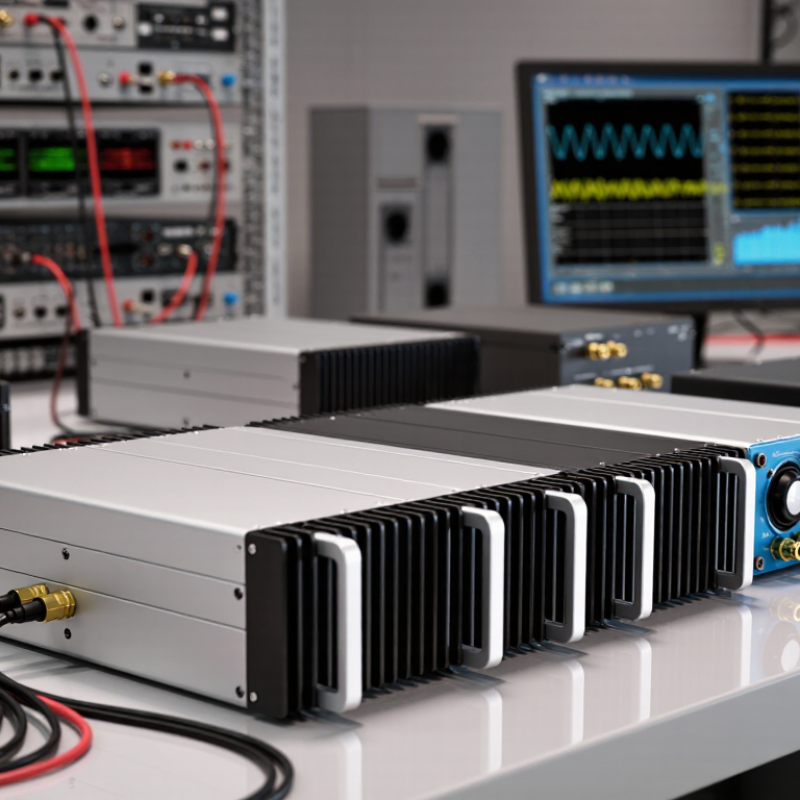
When comparing specifications, check gain, noise figure, output power, and operating bandwidth together. A high gain figure alone tells little. On a test bench, a spectrum analyzer can reveal unwanted harmonics that a simple power reading misses. Cooling also deserves attention: a compact metal enclosure may become warm during sustained operation. Not always obvious. Datasheets may not reflect every installation, so verify performance under the intended supply voltage, load, and temperature before choosing a unit.

How to Evaluate Chinese RF Amplifier Manufacturers

How to Evaluate Chinese RF Amplifier Manufacturers

Choosing an RF amplifier supplier takes more than comparing power ratings. Start with the operating range, gain, noise figure, output power, and linearity required by your system. Ask for test data at the frequencies and power levels you actually use. A neat specification sheet is useful, but it may not show performance across temperature or under continuous operation. Details matter.

Check how the manufacturer verifies each unit. Can it provide calibration records, production test procedures, and clear explanations of measurement conditions? Ask about component traceability, burn-in testing, and steps for handling failures. If possible, review a sample report or evaluate a sample unit in your own setup. Small differences in connectors, heat sinking, or cable loss can affect results. The bench tells the truth.

Communication is another practical measure. A reliable engineering team should answer technical questions directly and explain limits without promising perfect performance. Discuss lead times, customization, repair options, and documentation before ordering. Site visits or remote production audits may offer useful context, though they cannot replace independent testing. No supplier is flawless, and I would be cautious about treating one successful sample as proof of consistent production. Ask what happens when a batch falls outside its agreed specifications.

Cart Summary

Subtotal: $0