2026 Top Horizontal Ribbon Mixer Types for Buyers
A Horizontal Ribbon Mixer is a practical choice for blending dry powders and granules in a horizontal trough. In 2026, buyers will encounter several configurations, each suited to different materials, batch sizes, and production routines. A machine that handles free-flowing grains may behave differently with cohesive or heat-sensitive ingredients. That matters on the floor.
This guide introduces common options, including single- and double-ribbon designs, U-shaped troughs, jacketed vessels, and vacuum-capable models. Ribbon arrangement affects how material moves from the vessel ends toward the center, while trough shape and internal clearances influence mixing and cleanout. Features such as a bottom discharge valve, access doors, or a heating jacket can make a real difference. More features are not always better.
Buyers can compare mixer types by looking at working capacity, fill level, drive power, discharge needs, and cleaning access. Ask suppliers for data using materials similar to yours, not only free-flowing test powder. Request details on batch time, residual material, and maintenance access, then confirm important claims with a trial when possible. Specifications vary between manufacturers, and published figures may not reflect your process. A careful comparison can narrow the field, but it cannot replace testing. No model fits every line. That is easy to forget.
What Is a Horizontal Ribbon Mixer?
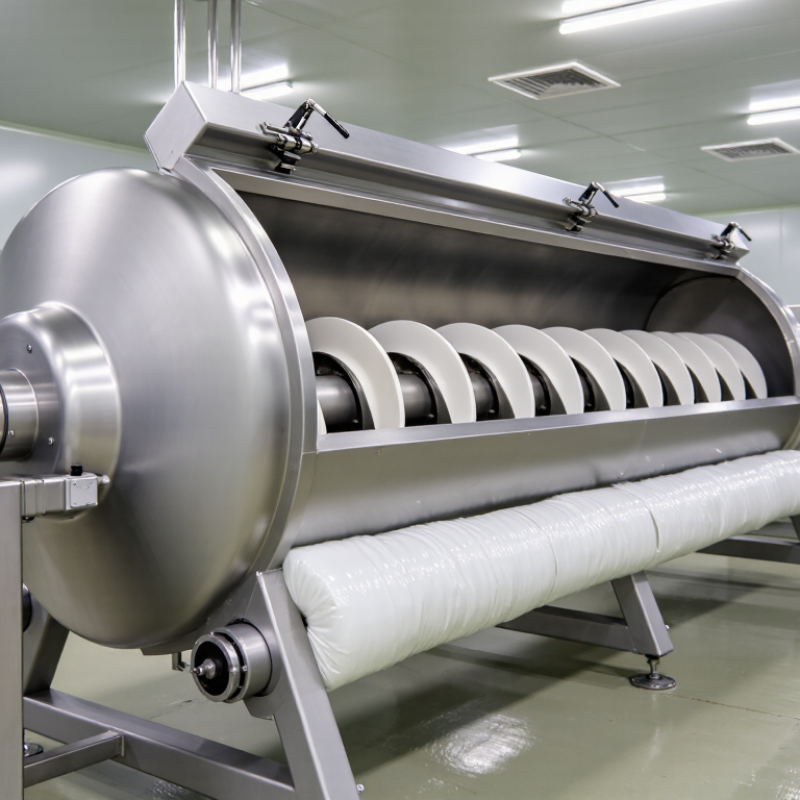
A horizontal ribbon mixer is a batch machine built around a long, U-shaped trough. A shaft runs through its center, carrying inner and outer helical ribbons. As the shaft turns, the ribbons move material along the trough and fold it back through the batch. This circulation helps blend dry powders and granules. Some designs can also handle measured liquid additions, depending on the material and equipment configuration.
The principle is straightforward. The details matter. Particle size, density, moisture, and fill level can all affect mixing performance. A trough filled too high may leave material poorly circulated, while a very small batch may not reach the ribbons effectively. Buyers should compare working capacity with their typical batch size, not just the machine’s total volume. They should also check discharge access, seals, and whether the contact surfaces suit their cleaning routine. I would not treat the name “ribbon mixer” as a performance guarantee. Even a well-built machine needs appropriate operating settings and trials with the actual ingredients. A small test batch can reveal dead spots that a specification sheet cannot.
2026 Top Horizontal Ribbon Mixer Types for Buyers: What Is a Horizontal Ribbon Mixer?
A horizontal ribbon mixer uses helical mixing elements mounted on horizontal shafts inside a trough. This chart compares two shaft configurations: single-shaft mixers have one mixing shaft, while twin-shaft mixers have two. Shaft count describes construction; it does not by itself indicate mixing quality, capacity, or performance.
How Does a Horizontal Ribbon Mixer Work?
How Does a Horizontal Ribbon Mixer Work?
A horizontal ribbon mixer blends materials inside a U-shaped trough. A motor turns a central shaft fitted with inner and outer helical ribbons. As they rotate, the ribbons move material in opposing directions. The outer ribbon typically pushes it toward one end, while the inner ribbon carries it back. This creates circulation across the mixer’s length and through the bed. The motion is steady. That matters when dry powders must mix evenly without relying on hand stirring.
Mixing quality depends on more than the ribbon design. Fill level, rotation speed, particle size, and material flow all affect circulation. Operators can look for stagnant pockets near the ends or beneath the shaft, then check samples from different points in the batch. A uniform appearance is useful, but it does not prove every ingredient is evenly distributed. That detail is easy to overlook. Discharge usually happens through a bottom valve, and residue can remain around the outlet if the material is sticky.
Tips: Follow the equipment maker’s loading and operating guidance. Avoid opening the mixer while it runs. For a new material, start with a small trial and compare samples from several locations. If results vary, review fill level and mixing time before increasing speed; more speed is not always better.
What Types of Horizontal Ribbon Mixers Are Available in 2026?
Mixer Configurations Horizontal ribbon mixers in 2026 are available in several configurations, each suited to different powder-flow and production needs. A single-ribbon design moves material in one main direction and often suits straightforward blending. A double-ribbon design uses inner and outer helices to move material in opposing directions, helping distribute ingredients through the trough. It is a common choice for dry powders and granules. Some machines combine ribbons with paddles, offering gentler handling or improved dispersion for recipes with varied particle sizes. Continuous horizontal ribbon mixers are also available for steady-feed production. Small differences matter.
Buyers can also specify jacketed troughs for heating or cooling, and contact surfaces designed for easier cleaning. These are options, not separate mixing principles. Grand View Research’s 2023 Industrial Mixers Market report estimated the global market at USD 2.1 billion in 2022, reflecting broad demand across processing industries; it does not isolate ribbon mixers. For selection, compare working volume, fill level, batch time, discharge design, and cleanability. Ask suppliers for trials using your actual ingredients, since bulk density and moisture can change performance. A polished specification can still miss the mark. Sizing is not always tidy.
Which Materials and Industries Suit Each Mixer Type?
A standard double-ribbon mixer suits free-flowing powders and small granules that need consistent blending. Its inner and outer ribbons move material in opposite directions, helping reduce stagnant zones when the vessel is correctly loaded. Flour blends, powdered drink bases, mineral premixes, and dry detergent ingredients are typical applications. That matters.
For fragile particles or ingredients with different bulk densities, lower speeds and careful fill levels can help limit breakage and segregation. Cohesive or mildly damp materials may suit a paddle-ribbon design or an added intensifier bar, although extra shear can generate heat. Dust changes things. Food and feed processors often value cleanable surfaces and quick discharge, while chemical and building-material plants may need greater wear resistance.
A jacketed trough can help control temperature for mixes containing fats or waxes, or products that soften during blending. Vacuum-capable designs may reduce trapped air in some powders and pastes, but they also bring added cleaning and maintenance demands. The awkward detail is that “gentle” depends on the product, not the mixer label. Before choosing capacity, test a representative batch for blend uniformity, residue near the discharge, and particle damage.
How Can Buyers Compare and Select a Horizontal Ribbon Mixer?
Choosing a horizontal ribbon mixer starts with the material, not the catalogue. Record bulk density, particle size, moisture, flow behavior, and batch size. A cohesive powder may need different ribbon geometry and operating speed than free-flowing granules. Compare working volume, not just total vessel capacity; underfilling or overfilling can leave uneven pockets. A polished specification sheet can still mislead.
The International Energy Agency’s Energy Efficiency 2023 report attributes roughly 37% of global energy consumption to industry. It is not a mixer-efficiency benchmark, but it makes motor power and energy per batch sensible comparison points. Ask suppliers for test results using your material, target load, and mixing time. Check blend uniformity at several vessel locations, then inspect discharge residue, cleanability, seal access, and wear surfaces. Small details matter. Also confirm that controls can repeat the chosen speed and cycle reliably.
Tips
Request a witnessed trial with representative material. Set an agreed uniformity target, sampling method, and test duration before comparing results. Measure energy per batch and note any dead zones near the ends or discharge. If samples vary, investigate the test setup too; sampling itself can distort the result. A second trial may be worthwhile.