How to Use Isothermal Amplification for Rapid Testing?
Isothermal Amplification is a powerful technique in molecular biology. It enables rapid testing for various pathogens. This method is gaining attention for its speed and efficiency.
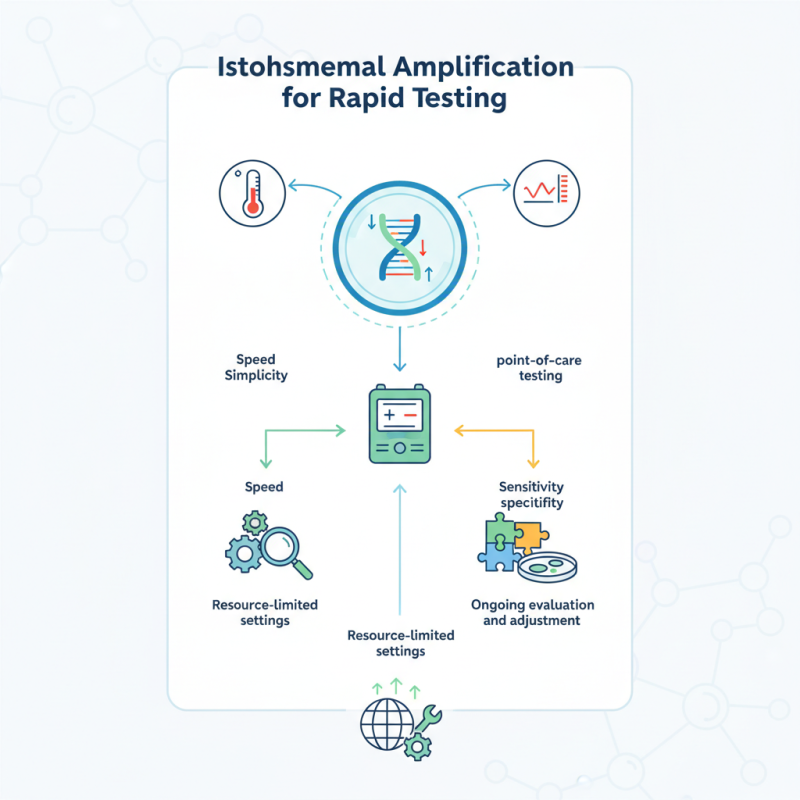
In traditional amplification methods, temperature cycling is necessary. Isothermal Amplification simplifies this by maintaining a constant temperature. This reduces the complexity of testing procedures and equipment needed. As a result, it is ideal for point-of-care testing.
However, not all applications may be suited for Isothermal Amplification. Sensitivity and specificity can vary between tests. Researchers must carefully validate each protocol to ensure reliability. Practical challenges remain, particularly in resource-limited settings. Adopting this technology requires ongoing evaluation and adjustment for optimal performance.
Understanding Isothermal Amplification: Principles and Techniques
Isothermal amplification is a powerful technique for rapid nucleic acid testing. Unlike traditional PCR, it operates at a constant temperature. This feature streamlines the process and reduces time significantly. The principles of isothermal amplification are based on enzyme-driven reactions. These reactions occur at a single temperature, facilitating quick and efficient amplification.
Various techniques exist within this domain, such as LAMP and RCA. LAMP, or Loop-mediated Isothermal Amplification, utilizes specific primers to enhance sensitivity. This method can generate thousands of copies of DNA in less than an hour. In contrast, RCA, or Rolling Circle Amplification, offers a distinct approach. It creates long DNA strands from a circular template, useful for certain applications.
The reliability of results can vary based on several factors. The quality of samples plays a crucial role. Contaminants might reduce amplification efficiency, leading to false negatives. Consistency in temperature is also vital. Any fluctuations could compromise the reaction. These challenges highlight the need for careful technique optimization. Testing conditions should be finely tuned to improve outcomes. Ensuring accuracy is essential for the credibility of rapid testing solutions.
Isothermal Amplification Techniques in Rapid Testing
Key Advantages of Isothermal Amplification for Rapid Testing
Isothermal amplification has transformed rapid testing in many fields. Its key advantage lies in the ability to operate at a constant temperature, eliminating the need for complex heating cycles. This simplifies the testing process, making it quicker and more accessible. According to a recent report by the National Institutes of Health, isothermal amplification can reduce detection times to as little as 30 minutes, compared to traditional methods that often take hours.
Another significant benefit is the high sensitivity and specificity of isothermal amplification techniques. Studies show that these methods can detect target nucleic acids at concentrations as low as 10 copies per microliter. This level of precision is critical in applications such as infectious disease diagnosis, where early detection can greatly impact patient outcomes. Furthermore, isothermal amplification possesses versatility. It can be adapted for various pathogens, including viruses and bacteria, in a range of sample types.
However, some challenges remain. For instance, there is a risk of non-specific amplification. This can lead to false positives, particularly in complex samples. Continuous optimization of reaction conditions is necessary to mitigate these issues. The community must remain vigilant in standardizing protocols to enhance the reliability of results across different environments.
How to Use Isothermal Amplification for Rapid Testing? - Key Advantages of Isothermal Amplification for Rapid Testing
| Advantage | Description | Applications | Limitations |
| Speed | Enables rapid amplification at constant temperatures within minutes. | Point-of-care diagnostics, infectious disease detection. | May require precise temperature control for optimal results. |
| Simplicity | Eliminates the need for complex thermal cycling equipment. | Field testing, resource-limited settings. | Limited multiplexing capabilities compared to PCR. |
| Cost-Effective | Uses inexpensive reagents and less equipment. | Affordable testing in low-resource environments. | Potential for lower sensitivity with certain targets. |
| Robustness | Can function in a wide range of conditions and sample types. | Environmental monitoring, veterinary diagnostics. | Possibility of non-specific amplification in complex samples. |
Applications of Isothermal Amplification in Disease Diagnostics
Isothermal amplification techniques have gained traction in recent years, especially for disease diagnostics. These methods allow for rapid amplification of nucleic acids at a constant temperature, streamlining the testing process. Unlike traditional PCR, isothermal methods do not require complex thermal cycling. This simplicity is key in emergency settings, where speed is vital.
One prominent application is in the diagnosis of infectious diseases. For instance, during outbreaks, quick detection of pathogens can save lives. Healthcare workers can obtain results in under an hour, enabling them to initiate treatment without delay. Additionally, these techniques prove useful in resource-limited settings, where access to advanced laboratory equipment is unavailable.
While isothermal amplification brings significant advantages, there are challenges. Contamination can lead to false positives, which is concerning in clinical settings. Moreover, not all isothermal methods achieve the same level of sensitivity. Each application should be assessed carefully to evaluate reliability. Continuous improvement and research are essential for refining these techniques and expanding their utility in diagnostics.
Comparative Analysis: Isothermal vs. Traditional PCR Methods
Isothermal amplification offers a compelling alternative to traditional PCR methods. It operates at a constant temperature, which simplifies the process and reduces the need for complex equipment. This feature lowers the barrier for rapid testing in various settings, from labs to field tests. Traditional PCR requires thermal cycling, which can prolong turnaround times. Isothermal methods can produce results in under an hour, making them ideal for urgent situations.
When considering the two, accuracy is critical. Isothermal amplification can yield specific results, similar to PCR. However, sensitivity may vary based on the target and the specific technique used. It’s crucial to choose the right method based on the testing scenario.
Tips: Ensure all reagents are prepared correctly to maintain test reliability. Run controls alongside your testing samples to validate results. Consider potential contamination, as isothermal amplification can be sensitive to environmental factors. Keeping equipment clean and using sterile techniques can help mitigate risks.
Future Prospects and Innovations in Isothermal Amplification Technology
Isothermal amplification technology has shown significant promise for rapid testing, especially in diagnostics. According to a market report by Research and Markets, the isothermal amplification market is projected to reach USD 3.5 billion by 2027, growing at a CAGR of 18.1% from 2020 to 2027. This rapid growth indicates increasing reliance on faster testing methodologies in healthcare sectors. The technology allows for quicker results without the need for expensive thermal cycling equipment.
Innovations in this field are evolving. New methods, such as loop-mediated isothermal amplification (LAMP), are being optimized. These methods can amplify genetic material at a constant temperature, reducing test times to under an hour. However, challenges remain, including sensitivity and specificity in varied environmental conditions. A recent study noted that environmental factors could affect results, highlighting the need for refined protocols.
Future innovations may include integrating isothermal amplification with portable diagnostic devices. This could allow testing in remote areas, especially in regions lacking healthcare infrastructure. While the outlook is promising, ongoing research must address technical limitations. This will ensure that isothermal amplification meets the growing demand for rapid, reliable testing solutions.