How to Choose a Single VSD Compressor?
Choosing a Single Vsd Compressor is not simply a matter of selecting the highest horsepower or lowest purchase price. The right decision begins with your actual air demand. Record pressure levels, operating hours, leakage, production changes, and peak flow. A compressor that performs well beside a packaging line may struggle in a metalworking plant with sudden demand spikes. Small details matter, including pipe size, receiver volume, inlet temperature, and maintenance access.
Ron Marshall, a respected compressed-air systems specialist, has emphasized, “Compressed air is one of the most expensive utilities in a plant.” This principle should guide every comparison. Variable speed drive technology can reduce energy waste when demand changes frequently. However, savings depend on correct sizing, control settings, motor efficiency, and system pressure. A VSD unit running continuously near full load may offer little advantage over a fixed-speed model. That is easy to overlook.
A reliable evaluation should compare lifecycle cost rather than the invoice alone. Review specific power, service intervals, cooling requirements, warranty terms, and local technical support. Ask suppliers for performance data at your working pressure, not only promotional figures. Measure the installation space, because a compact machine still needs airflow and safe clearance. Consider redundancy, too. One large compressor may be efficient, yet two smaller units can protect production during servicing.
There is no universal answer. Your demand profile decides. Even experienced engineers can misjudge future growth. Recheck the assumptions before approving the purchase. A practical Single Vsd Compressor selection balances efficiency, reliability, control flexibility, and the realities of your facility.
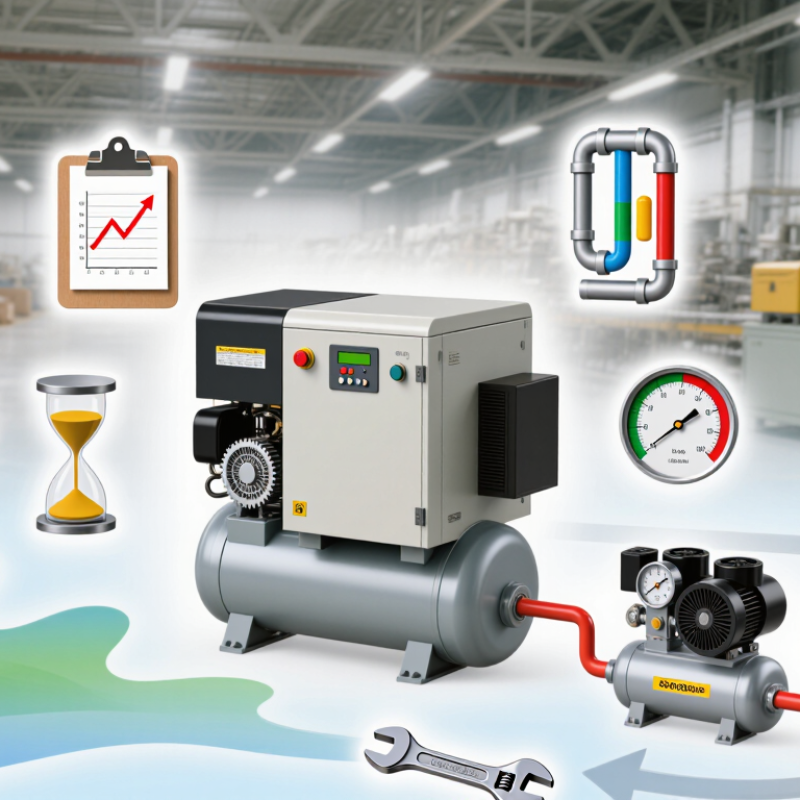
Define the Role and Air-Demand Profile of a Single VSD Compressor
How to Choose a Single VSD Compressor?
A single VSD compressor should match the plant’s real air-demand profile, not its largest theoretical load. Define its role clearly before comparing power ratings. It may serve as the main compressor, a trim unit, or the only source during changing shifts. Each role requires different control behavior. A trim unit reacts frequently. A base-load unit runs more steadily.
Measure demand across several production days. Record flow, pressure, operating hours, and major equipment changes. Include start-up peaks, weekend demand, and short pressure drops. These details reveal whether demand is stable, seasonal, or highly variable. A compressor sized only for peak demand may spend too much time running lightly loaded. That wastes energy and can increase maintenance stress. A better decision uses measured data, receiver capacity, and the required pressure at the farthest point.
Tips: Install temporary flow and pressure meters if records are incomplete. Compare the minimum, average, and peak flow values. Check whether leaks create a false demand signal. Set the pressure target as low as production safely allows. Ask the supplier for performance data at your actual pressure range, not only the headline rating. Leave some capacity margin, but question every extra percentage. Oversizing feels safe. It is not always efficient. Recheck the profile after commissioning, because production habits often change.
How to Choose a Single VSD Compressor?
Define the Role and Air-Demand Profile of a Single VSD Compressor
The profile shows a realistic variable-demand production day, with lower demand during breaks and higher demand during peak operating periods. A single VSD compressor can adjust output to follow changing demand, helping reduce unloaded running and excess pressure compared with operating continuously at full capacity.
Calculate Required Flow, Pressure, and Operating Range
How to Choose a Single VSD Compressor?
Calculate Required Flow, Pressure, and Operating Range
Choosing one variable-speed-drive compressor starts with measured demand, not the largest machine. Record flow during idle, normal production, and peak shifts for at least seven days. Use a calibrated flow meter, pressure logger, and receiver readings. The U.S. Department of Energy reports that compressed air can consume 10–15% of plant electricity. That makes poor sizing expensive.
Calculate required flow from actual demand plus confirmed leakage, not guesswork. The DOE sourcebook notes that leaks may waste 20–30% of compressor output. A practical audit should separate process air from artificial demand, such as open blowing or oversized nozzles. Set pressure from the least-tolerant device, then add only verified distribution and treatment losses. ISO 11011 recommends measurement, performance, and energy analysis when assessing compressed-air systems. Do not confuse free-air delivery with inlet volume.
Plot minimum, average, and maximum flow against pressure across the operating range. Choose a VSD whose efficient control zone covers normal demand, while fixed-speed trim handles brief peaks. Check turndown, motor limits, cooling conditions, and restart frequency. A wider range is not automatically better. My first sizing attempt would probably overstate peak demand if weekend data were missing. That error deserves a second review before purchase.
How to Choose a Single VSD Compressor? - Calculate Required Flow, Pressure, and Operating Range
Worked design basis: The following example uses a compressed-air system with three representative demand conditions. Flow is expressed as free air delivery (FAD) in m³/min, and pressure is expressed as bar(g).
1. Required Input Data | Design Parameter | Example Value | Unit | Why It Matters |
| Minimum operating flow | 3.0 | m³/min FAD | Represents the lowest sustained demand during normal production. |
| Normal operating flow | 6.0 | m³/min FAD | Represents the typical average demand during the main operating period. |
| Peak operating flow | 8.0 | m³/min FAD | Represents the highest measured or calculated simultaneous demand. |
| Future expansion allowance | 5 | % of peak flow | Provides limited capacity for known near-term expansion without excessive oversizing. |
| Leakage and measurement allowance | 10 | % of peak flow | Covers estimated distribution losses, measurement uncertainty, and unaccounted demand. |
| Highest required point-of-use pressure | 7.2 | bar(g) | Defines the pressure needed at the most demanding equipment connection. |
| Distribution and treatment pressure loss | 0.3 | bar | Allows for pressure loss through piping, filters, dryers, valves, and fittings. |
| Control margin | 0.3 | bar | Provides a practical margin for stable pressure control and short demand changes. |
2. Flow and Pressure Calculation | Calculation Item | Formula | Calculation | Result |
| Future peak demand | Peak flow × (1 + future allowance) | 8.0 × (1 + 0.05) | 8.40 m³/min FAD |
| Design required flow | Future peak demand × (1 + leakage allowance) | 8.40 × (1 + 0.10) | 9.24 m³/min FAD |
| Required compressor discharge pressure | Point-of-use pressure + system pressure loss + control margin | 7.2 + 0.3 + 0.3 | 7.8 bar(g) |
| Recommended design pressure | Required discharge pressure rounded to the available pressure class | 7.8 bar(g) rounded upward | 8.0 bar(g) |
3. Operating Range for a Single VSD Compressor | Operating Condition | System Flow | Required Pressure | VSD Compressor Response | Selection Check |
| Minimum sustained demand | 3.0 m³/min FAD | 6.5–7.0 bar(g) | Reduce motor speed while maintaining the pressure setpoint. | The compressor's stable minimum flow should be at or below 3.0 m³/min. |
| Normal demand | 6.0 m³/min FAD | 7.0–7.5 bar(g) | Operate in the mid-speed range, where efficient modulation is normally available. | Normal demand should not be close to the compressor's maximum capacity. |
| Original peak demand | 8.0 m³/min FAD | 7.5 bar(g) | Increase motor speed to meet short-term peak demand. | Available capacity should exceed 8.0 m³/min at the required pressure. |
| Future peak plus allowances | 9.24 m³/min FAD | 8.0 bar(g) design pressure | Operate near the upper end of the selected VSD capacity without exceeding its continuous rating. | Selected capacity should be at least 9.24 m³/min FAD at 8.0 bar(g). |
4. Recommended Selection Specification | Specification | Recommended Requirement | Engineering Reason |
| Compressor type | Single variable-speed drive compressor | Suitable for systems with continuously varying demand and a wide load profile. |
| Rated free air delivery | At least 9.24 m³/min at 8.0 bar(g) | Matches the calculated future peak flow, leakage allowance, and expansion allowance. |
| Required stable operating range | Approximately 3.0–9.24 m³/min FAD | The compressor must track the minimum sustained demand without unstable cycling and meet the design peak. |
| Pressure control range | Approximately 6.5–8.0 bar(g) | Covers the expected operating pressure while maintaining the required point-of-use pressure. |
| Control setpoint | Normally 7.5–7.8 bar(g), subject to commissioning verification | The lowest practical setpoint reduces unnecessary pressure-related energy consumption. |
| Minimum turndown capability | At or below 3.0 m³/min FAD at the selected pressure | Prevents frequent unloading, venting, or start-stop operation during low demand. |
| Maximum continuous capacity | Higher than 9.24 m³/min FAD at 8.0 bar(g) | Ensures the compressor can continuously satisfy the calculated design demand rather than only a short-term peak. |
| Flow measurement basis | FAD referenced to the applicable measurement standard | Prevents incorrect comparison between compressor capacity, plant demand, and supplier performance data. |
5. Final Verification Checklist | Verification Item | Acceptance Requirement | Status for This Example |
| Capacity at rated pressure | Compressor output must be at least 9.24 m³/min FAD at 8.0 bar(g). | Required |
| Low-load stability | Compressor must operate stably at or below 3.0 m³/min FAD without excessive cycling. | Required |
| Pressure setpoint | Setpoint should be high enough for the farthest user but not higher than necessary. | Verify on site |
| Receiver and control response | Confirm that the air receiver volume and control logic can handle rapid load changes. | Verify on site |
| Electrical compatibility | Check motor power, supply voltage, starting current, harmonics, ventilation, and ambient temperature. | Verify before purchase |
| Operating environment | Confirm altitude, inlet temperature, humidity, cooling requirements, and enclosure rating. | Verify before purchase |
| Performance documentation | Request certified or clearly defined FAD data at the selected pressure and reference conditions. | Required |
Key result: For the stated design basis, a single VSD compressor should provide at least 9.24 m³/min FAD at 8.0 bar(g) and operate stably across an approximate flow range of 3.0–9.24 m³/min FAD. Final selection should be confirmed using site measurements and the compressor supplier's performance data at the actual operating conditions.
Compare VSD Compressor Technologies and Key Specifications
How to Choose a Single VSD Compressor?
Compare VSD compressor technologies before comparing purchase prices. A variable-speed drive adjusts motor speed as air demand changes, unlike fixed-speed control, which repeatedly loads and unloads. The U.S. Department of Energy reports that compressed-air leaks can waste 20–30% of compressor output. Therefore, a wider turndown range may not solve an unstable piping system.
Look beyond rated horsepower. Compare actual flow at working pressure, minimum stable speed, motor efficiency, inverter cooling, and harmonic performance. The International Energy Agency estimates that electric motors consume about half of global electricity, making motor efficiency a serious operating-cost issue. A permanent-magnet motor can improve part-load efficiency, while an induction motor may offer simpler maintenance and wider service familiarity. Neither option is automatically better.
Check the numbers carefully. DOE guidance recommends measuring demand profiles instead of sizing from connected equipment alone. Record pressure every few seconds during shifts, then compare peak flow, average flow, and idle periods. A 7-bar compressor may appear suitable, but pressure losses could require excessive discharge pressure. That wastes energy. Field readings can also expose a flawed assumption: a smooth production schedule may still contain sharp, five-minute demand spikes. Ask for ISO 1217 performance data, sound levels, service intervals, and inverter fault records. Cheap capacity can become expensive capacity.
Evaluate Energy Efficiency, Controls, Installation, and Maintenance
Choosing a single VSD compressor requires more than comparing motor power. Start with your real air demand, including peak shifts, leaks, and idle periods. A variable speed drive can reduce energy use during changing demand, but poor sizing may create frequent cycling and unstable pressure. Review the compressor’s specific power at several load points, not only its best published figure. Measure pressure at the point of use. A small pressure drop can increase operating costs.
Tips: Record one week of demand data. Check morning peaks. Test for leaks. Ask for service records. Use verified measurements.
Controls should be simple enough for operators to understand. Look for adjustable pressure bands, fault history, remote monitoring, and clear alarm messages. In practical installations, confusing screens can delay responses. I have seen energy targets fail because sensors were installed too close to heat sources. That detail matters. Calibration also drifts, so maintenance intervals should be realistic rather than copied from a brochure.
Installation planning affects reliability. Leave safe access around filters, coolers, drains, and electrical panels. Confirm ventilation before delivery, especially in a compact plant room. Check cable sizing, grounding, and starting requirements with a qualified technician. Maintenance should include filter inspection, oil analysis where applicable, cooler cleaning, and drive cooling checks. No selection is perfect. Your operating conditions may change. Review performance after several months, and question any result that looks unusually good.