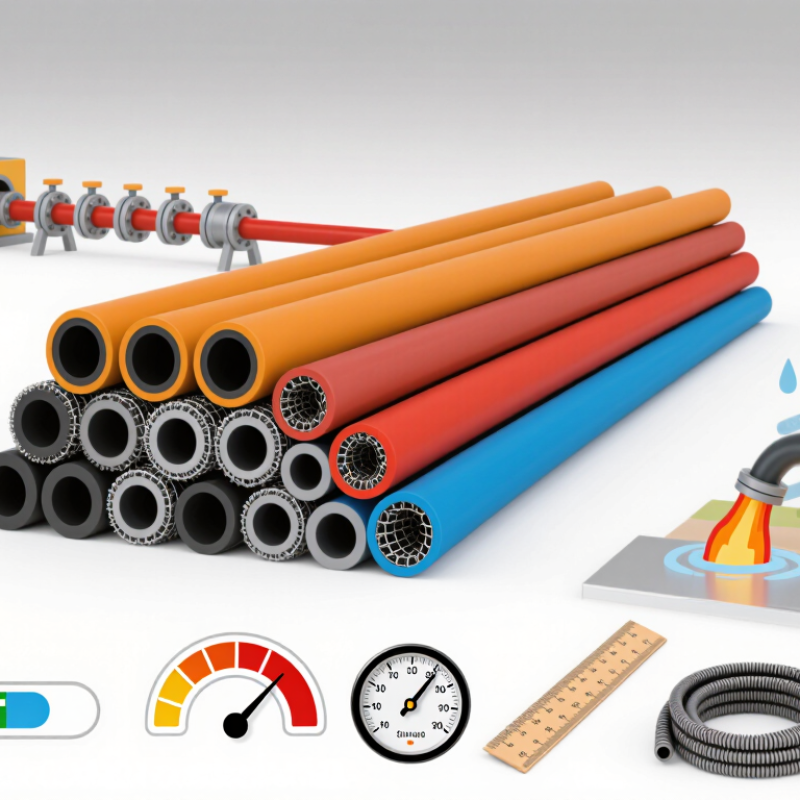
How to Choose the Right Heat Resistant Rubber Hose

Choosing the right Heat Resistant Rubber Hose starts with the conditions it must actually face, not a temperature figure on a product page. That number is useful, but it does not tell the whole story. A hose near a furnace may see radiant heat, while a line carrying hot oil faces direct contact and pressure. Steam, chemicals, vibration, and outdoor exposure can change the choice, too. Small details matter. Record the normal and peak temperatures, working pressure, fluid, hose length, and bend radius before comparing products. Check whether the stated temperature rating applies continuously or only for short periods.

Next, match the hose construction and end connections to the service. Tube materials, reinforcement, cover compounds, and fittings all affect performance. Fit matters. Confirm compatibility using the manufacturer’s technical data, and ask for clarification when the application falls outside the published range. A hose that tolerates heat may still fail early if it is kinked, stretched, or exposed to pressure spikes. It is tempting to choose the highest temperature rating and move on. That shortcut can overlook flexibility, abrasion, or fitting limits. A little uncertainty is worth investigating.

For a dependable decision, compare documented ratings with the real installation, then inspect the hose after fitting and during service. Look for hardening, cracks, blistering, leaks, or loose connections. Follow the supplier’s replacement guidance and site maintenance procedures. No hose is universally suitable. Careful selection reduces avoidable risk, but it cannot replace correct installation or regular inspection. A qualified hose supplier can review unusual heat sources, mixed fluids, or demanding duty cycles before purchase.

How to Choose the Right Heat Resistant Rubber Hose

What Defines a Heat-Resistant Rubber Hose?

How to Choose the Right Heat Resistant Rubber Hose

What Defines a Heat-Resistant Rubber Hose?

A heat-resistant rubber hose is designed to retain useful flexibility, strength, and sealing performance at elevated temperatures. Its limit depends on the rubber compound, reinforcement, conveyed fluid, pressure, and exposure time—not just the outer cover. That matters. A hose carrying hot oil may age differently from one exposed to hot air, even at the same temperature.

ASTM D573, Rubber—Deterioration in an Air Oven, includes comparison conditions such as 70°C for 168 hours. This is an accelerated aging test, not a universal service-life prediction or hose rating. ISO 188 likewise specifies methods for testing accelerated ageing and heat resistance. Together, these standards show why ratings should be tied to test conditions and the exact hose construction. A temperature figure without pressure, medium, and duration can mislead.

Tips: Check the manufacturer’s stated continuous and intermittent temperature limits, then confirm they cover your fluid and operating pressure. Inspect for hardening, cracks, or soft spots after service. Real installations are messy; sharp bends and nearby hot surfaces can undermine an otherwise suitable hose.

Which Operating Conditions Must the Hose Withstand?

A heat-resistant hose must survive the actual temperature at its wall, not just the number shown on a process display. Measure normal operating heat, brief spikes, and how long each exposure lasts. Peak temperature matters. A hose near a hot exhaust, oven door, or steam line may face radiant heat as well as hot fluid. Ambient temperature, airflow, and nearby surfaces can change its real thermal load.

ASTM D2000 lists heat-resistance letter grades from A at 70°C to K at 300°C. These are material classification test temperatures, not automatic hose-service ratings. Check the manufacturer’s stated continuous and intermittent limits for the complete hose assembly. Pressure also matters: heat can soften rubber, while pressure, vacuum, or repeated bending adds stress. A hose that handles hot air may not suit oil, coolant, or steam. Not just heat.

Consider the fluid’s chemistry, pressure cycles, vibration, and cleaning routine. ISO 188 describes accelerated heat-ageing tests for rubber, helping assess changes after controlled exposure. But accelerated testing cannot reproduce every field condition. I would treat published limits as a starting point, then verify the exact fluid, temperature profile, and pressure with the supplier. One awkward detail: installations rarely stay steady. A short temperature spike can matter more than an average reading, especially when the hose is clamped tightly or rubs against a metal edge.

How Do Hose Materials and Reinforcement Affect Performance?

How to Choose the Right Heat Resistant Rubber Hose

Hose material determines more than the maximum temperature on a product sheet. Silicone remains flexible across wide temperature changes, making it useful near hot air ducts and engine compartments. However, it may not suit every oil or fuel exposure. EPDM often handles hot water, steam, and weathering well, while oil-compatible elastomers are better for many lubricant lines. Check the hose’s stated compatibility with the actual fluid, not just its temperature rating.

Reinforcement controls how a hose behaves under pressure, bending, and repeated movement. Textile braids can support flexible, lighter-duty assemblies. Wire reinforcement can provide greater strength in demanding pressure conditions, but may make the hose less flexible. Think about the route: a tight bend behind a machine can strain the reinforcement and restrict flow. Measure the bend radius and confirm the required working pressure, including pressure changes during operation.

Details matter. A hose near a furnace may face radiant heat on its outer cover, while the inside carries a cooler fluid. In that case, both temperatures deserve attention. Also consider vibration, fittings, and how often the line moves. Ratings can be easy to misread; maximum temperature alone does not describe safe continuous service. Compare the manufacturer’s pressure and temperature limits for the specific medium and duty cycle. The right choice is not always the most heavily reinforced one. It depends on the whole installation.

How Should Temperature, Pressure, and Size Ratings Be Compared?

Compare hose ratings under the conditions it will actually face. A temperature rating may describe continuous service, short exposure, or a specific test. These are not interchangeable. Check the expected fluid temperature and the heat around the hose, especially near engines, ovens, or hot pipes. A brief spike can still matter. If the manufacturer does not explain the rating basis, ask before selecting the hose.

Pressure needs the same careful reading. Use the working-pressure rating, not the burst-pressure figure, and check whether heat reduces the allowable pressure. Pumps and valves can create short pressure surges that a steady gauge reading will miss. Leave a suitable safety margin for those changes.

Hose diameter matters too: match the inside diameter to the fittings and required flow, then verify the outside diameter fits clamps or guards. A smaller bore can restrict flow; a larger one may not seal properly. Check bend radius as well. Tight bends can flatten the hose, even when its printed ratings look adequate.

Specifications can still leave questions. Real installations are rarely perfect.

How Can You Verify Compatibility and Safety Before Selection?

How to Choose the Right Heat Resistant Rubber Hose

How Can You Verify Compatibility and Safety Before Selection?

Start with the real operating conditions, not the hose’s maximum temperature claim. Record the fluid, concentration, temperature, pressure, and exposure time. Include brief heat spikes. They matter. Check the hose maker’s published limits for continuous and intermittent service, because temperature can reduce allowable pressure and shorten service life. A rating for hot air does not prove compatibility with hot oil or cleaning chemicals.

Request test records for the exact hose construction. ISO 1402:2021 describes hydrostatic pressure testing for rubber and plastics hoses; ASTM D380 provides methods for testing rubber hose. These standards describe test procedures, not a universal pass rating. Compare the report’s proof pressure, burst pressure, leakage, and test temperature with your operating conditions and the hose’s stated limits. For hydraulic hose, some specifications use a 4:1 burst-to-working-pressure ratio, but that figure should not be applied automatically to every hose type.

Check the full assembly, including fittings, clamps, and bends. A hose can pass a bench test yet fail where it rubs against a sharp bracket or sits beside an exhaust pipe. Look for cracking, softening, blistering, or exposed reinforcement during inspection. Keep a record of installation date and service conditions. I would still question a perfect-looking test sheet if it covers a different size, lining, or fitting. Test the actual setup when consequences of failure are serious.

How to Choose the Right Heat Resistant Rubber Hose - How Can You Verify Compatibility and Safety Before Selection?

Service or Media Possible Hose-Lining Material to Screen Compatibility Checks Temperature and Pressure Checks Safety Verification Before Selection
Hot water or aqueous fluids EPDM is commonly considered for hot water service; the actual compound and hose construction must be confirmed. Check the fluid’s additives, cleaning chemicals, concentration, and exposure duration against the hose supplier’s compatibility data. Confirm the hose’s rated working temperature and pressure together. Hot service can reduce allowable pressure; do not rely on a temperature rating alone. Verify the complete assembly, including end connections, seals, and clamps, is suitable for the operating conditions. Check applicable potable-water requirements if the fluid is for consumption.
Saturated steam Use a hose specifically designed and identified for steam service; do not assume a general-purpose EPDM or rubber hose is suitable. Confirm the hose is approved for saturated steam, and check whether superheated steam, condensate, or cleaning chemicals are present. Match the steam pressure to its saturation temperature and the hose’s steam-service rating. Account for pressure cycling and temperature at the hose, not just at the boiler. Check assembly and inspection requirements in the applicable specification, such as ISO 6134 where relevant. Follow the hose maker’s installation, inspection, and replacement instructions.
Hot oil or petroleum-based fluids NBR or FKM may be candidates for screening, depending on the exact oil, temperature, and hose design. Identify the oil type, additives, and any fuel or solvent content. Verify compatibility of the tube, cover, and seals; one suitable layer does not establish whole-hose compatibility. Check the rated temperature and pressure for the specific fluid and duty cycle. Include surge pressure, continuous exposure, and any periods of elevated temperature. Confirm permeation, fire-risk controls, and electrical-conductivity requirements where relevant. Verify that fittings and seals are rated for the same service.
Hot air or dry gas EPDM, silicone, or other heat-resistant constructions may be considered, subject to pressure, gas, and application requirements. Check for ozone, oil mist, chemicals, and gas permeation. Confirm the material is suitable for the specific gas and is not merely rated for hot air. Verify temperature and pressure ratings for the assembled hose. For suction service, check vacuum resistance and the minimum bend radius. Confirm the hose cannot collapse, kink, or loosen under operating conditions. Check whether gas permeability or static charge presents a hazard.
Hot chemical solutions PTFE-lined or other chemically resistant hose constructions may be candidates; selection depends on the chemical and full assembly design. Record the chemical name, concentration, temperature, mixture, and cleaning agents. Consult a compatibility chart or obtain written confirmation for the exact conditions. Check pressure derating at operating temperature, permeation limits, and resistance to pressure cycling. A lining’s chemical resistance does not by itself establish the pressure rating. Verify fitting material, liner retention, and assembly configuration. For regulated chemical service, check applicable local requirements and the relevant hose specification, such as EN 12115 where applicable.
Hot abrasive slurry Abrasion-resistant rubber lining may be considered, with the compound selected for both the slurry and temperature. Assess solids type, particle size, concentration, flow velocity, and any corrosive liquid phase. Ask for wear data relevant to the actual duty. Confirm temperature and working-pressure limits, plus resistance to vacuum or pulsation if present. Consider the effect of bends and flow direction on wear. Inspect for cover damage, exposed reinforcement, leakage, and excessive wear at bends. Establish an inspection and replacement schedule based on service conditions.
Intermittent hot service or thermal cycling Select a construction rated for the actual peak temperature and repeated heating and cooling; material name alone is not sufficient. Check compatibility during both hot operation and cool-down, including condensation, cleaning, and chemical concentration changes. Record minimum, normal, and peak temperatures, exposure time, pressure changes, and cycle frequency. Verify ratings for the complete hose assembly. Check for thermal expansion, movement, abrasion, and strain at fittings. Support and route the hose according to the supplier’s instructions.

Important: Material names in this table are screening guidance, not approval for a particular hose. Temperature and pressure capabilities vary by compound, reinforcement, diameter, fittings, and service conditions. Before purchase, verify the exact hose assembly’s technical data and compatibility with the hose supplier, and use the most demanding credible operating condition.

Cart Summary

Subtotal: $0