What Are the Best Gasket Rings in 2026?
Choosing the best Gasket Rings in 2026 is less about finding one “winner” and more about matching material, pressure, temperature, and fluid. A ring that seals cleanly on a cool water line may fail in a hot, vibrating pump. Small details matter: flange finish, bolt load, and chemical compatibility can change the result. The choice is rarely simple.
Grand View Research’s Industrial Gaskets Market report estimated the market at about $12.4 billion in 2023 and projected roughly 5.2% annual growth through 2030. That figure covers industrial gaskets broadly, not gasket rings alone. Still, it signals growing demand across equipment and process industries. For selection context, John H. Bickford, a specialist in bolted-joint design, is often cited for a practical principle: gasket performance depends on the entire bolted joint, not the sealing material by itself. This is a paraphrase of his engineering work, not a verbatim quotation. The distinction matters.
This guide compares common ring materials, including elastomers, graphite, and PTFE, against real operating needs. It also considers installation, service life, and the cost of an avoidable leak. Data helps, but it cannot replace a careful review of the actual joint. Some ratings look precise. Field conditions are not.
What Gasket Rings Are and How They Work
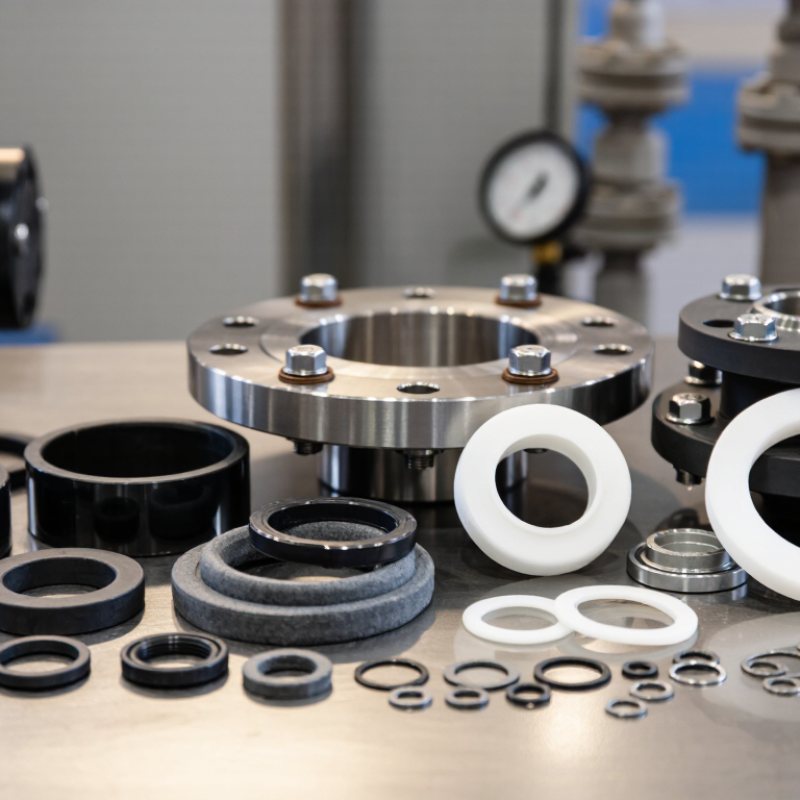
A gasket ring is a circular sealing element fitted into a groove between two mating surfaces. When the joint closes, the ring deforms slightly and presses against those surfaces, blocking a path for liquid or gas. O-rings commonly seal static joints, such as pipe connections, while specially designed rings can work around moving shafts or pistons. Small part. Critical job.
The seal depends on more than material choice. Groove dimensions, surface finish, temperature, pressure, and fluid compatibility all affect performance. Too little compression may leave a leak path; too much can damage the ring or shorten its service life. The U.S. Department of Energy’s Improving Compressed Air System Performance sourcebook reports that leaks can waste 20–30% of compressed-air output in poorly maintained systems. That figure covers system leaks, not gasket rings alone. I would not treat it as a gasket failure rate; it is a useful warning about small sealing defects. During inspection, look for flattened sections, cracks, hardening, or signs of extrusion at the groove edge. A ring can look sound and still fail under heat or pressure. That part is easy to miss. A careful match to operating conditions matters more than choosing a ring by appearance.
What Are the Best Gasket Rings in 2026? How They Work
Gasket rings are compressed between mating surfaces to help prevent fluid or gas leaks. The best material depends on the temperature, pressure, media, and flange design—not temperature range alone.
Typical temperature ranges shown in °C. Actual limits vary by material grade, operating conditions, and gasket design; consult the product specification for a specific application.
Common Gasket Ring Materials and Their Properties
What Are the Best Gasket Rings in 2026?
Common Gasket Ring Materials and Their Properties
There is no single best gasket ring for every job. Material choice depends on the fluid, temperature, pressure, and flange condition. A ring that seals well on a clean, smooth flange may struggle on a scratched surface. Small details matter.
Nitrile rubber (NBR) is commonly used with oils and fuels, but it is not suitable for every hot or outdoor application. EPDM handles water, weather, and many steam services, yet performs poorly with petroleum oils. Fluoroelastomer (FKM) can tolerate higher temperatures and many chemicals; check compatibility for the specific fluid. PTFE resists a wide range of chemicals and has a low-friction surface, though it can deform under sustained load. Graphite suits many high-temperature applications, while spiral-wound rings combine metal reinforcement with a sealing filler. Each has limits.
Material charts can make selection seem tidy; real service rarely is. Review the manufacturer’s temperature and pressure ratings, then compare them with actual operating conditions, including brief temperature spikes. Also inspect flange finish and bolt loading. A soft rubber ring may seal uneven surfaces, but excessive compression can damage it. A rigid metal ring needs suitable flange alignment and finish. If conditions are uncertain, verify the choice with a qualified sealing specialist rather than relying on material names alone.
Types of Gasket Rings and Their Applications
Gasket rings are not interchangeable, even when they look similar on a workbench. Their shape and material affect how they seal under heat, pressure, and vibration. Sheet gaskets suit many flat-flange connections in pumps, pipes, and equipment housings. They are often cut to size, but a rough edge or uneven compression can cause leakage. Details matter.
Spiral-wound gaskets combine thin metal windings with a softer filler. They are commonly used on flanged piping where temperature and pressure fluctuate. Ring-joint gaskets use a solid metal ring seated in matching grooves, often in high-pressure service. Their sealing depends on precise groove dimensions and careful installation. Fit is unforgiving. Elastomer rings, including O-rings, work well in compact fittings and moving assemblies, provided the material tolerates the fluid and operating temperature. PTFE rings offer broad chemical resistance, though cold flow under sustained compression deserves attention.
Selection starts with the actual service conditions, not just the pipe size. Check the media, temperature range, pressure, flange finish, and required compression. A clean flange and even bolt tightening matter as much as the gasket itself. Maintenance records can reveal repeat failures that a specification sheet misses. A material chart may suggest a good match, yet real service conditions are sometimes messier than the chart allows.
How to Compare Gasket Ring Performance in 2026
Comparing gasket rings in 2026 means testing the joint, not trusting a material label. Start with service temperature, pressure, fluid, flange finish, and bolt load. ASTM F36 measures compressibility and recovery; ASTM F37 evaluates sealability, while ASTM F38 measures creep relaxation. These methods reveal different weaknesses. A soft sheet may seal quickly, yet lose clamp load after heat cycling. A stiffer ring can resist extrusion but require flatter flanges and careful bolt sequencing. Match test conditions to the actual service envelope. A laboratory number alone is not a field guarantee.
Leakage deserves attention. The IEA’s Global Methane Tracker 2024 estimated around 120 million tonnes of methane emissions from fossil-fuel operations in 2023. That figure is not specific to gasket rings, so it cannot serve as a gasket failure rate. It does show why measured emissions matter. Compare leak rates at stated pressure, retained bolt load after thermal cycles, chemical compatibility, and installation repeatability. ASME PCC-1 provides guidance for bolted-flange assembly and controlled tightening. Record flange condition during trials. Small omissions matter. Specifications can look precise while leaving surface damage unrecorded; that gap deserves a second look. Re-test after maintenance, because flange faces change over time.
How to Select and Install the Right Gasket Ring
Choosing a gasket ring starts with the joint, not the shelf. Check the groove or flange dimensions, then confirm the ring’s inside diameter and cross-section. Even a small mismatch can cause uneven compression or leave a leak path. Consider the fluid, operating temperature, pressure, and cleaning chemicals before selecting a material. A ring suited to warm water may swell or harden in another service.
Inspect the mating surfaces under good light. Remove old residue and grit with a method approved for the equipment, then check for scratches, corrosion, or dents. Clean surfaces matter. Make sure the ring is not twisted, stretched, cracked, or flattened before fitting it. Lubrication can help in some assemblies, but only use a lubricant compatible with both the gasket material and the process fluid. This detail is easy to underestimate.
Fit the ring evenly into its groove without pulling it into place. Align the components before tightening, and follow the equipment maker’s specified sequence and torque; excessive force can distort the ring or flange. After assembly, test the joint under the prescribed conditions and watch for seepage or pressure loss. If leakage continues, stop and inspect the dimensions, surface condition, and material choice rather than simply tightening harder. A careful installation helps, but it cannot compensate for a gasket selected for the wrong service.