AirAccess Access Control as a Service Platform with Auto-Cell Networking (ACasS)
Enterprise Hosted Platform - MVPAccess™
New! Napco Access 1 & 2-Door Controllers
Please contact us directly or visit our FAQ page or Video Library.
Toll Free 800-645-9330
Phone 631-842-9400
Fax 631-842-9135
Email: sale@safehomeexpert.com
sale@safehomeexpert.com (Latin America)
Sign up for integrator training seminars. 2 days and 3 day online courses are available from our directory indexed by product.
Learn MoreOffer the one access control solution powerful and flexible enough to protect all of your clients. Continental Access provides state-of-the-art access control software and hardware in an easy-to-implement and easy-to-use access control solution that seamlessly integrate with a wide range of facility management products.
Learn MoreA modern warehouse rarely has one perfect storage pattern. Product mix changes. Order volumes shift. Aisle space stays stubbornly limited. A Shuttle Racking System can help, but the right design depends on the work behind each pallet: how often it moves, how quickly it must be reached, and whether stock rotates by date or batch.
This guide compares the main shuttle racking types expected to shape warehouse planning in 2026, including FIFO and LIFO layouts, single- and multi-level systems, and configurations designed for different throughput needs. It also considers practical trade-offs: lane depth, pallet consistency, shuttle availability, charging routines, and the space needed for service access. Small details matter. A deep lane may increase density, yet it can also make replenishment planning less forgiving.
For transparency, no source article or verified expert quotation was provided. The following is an illustrative line, not a real attribution: fictional warehouse systems engineer Alex Morgan says, “Choose the shuttle around the flow, not the floor plan alone.” That principle is useful, though incomplete; labor, maintenance, and future product changes deserve equal attention. A system that looks efficient on a drawing may behave differently during a busy shift. The sections ahead offer a clear framework for comparing options, asking vendors specific questions, and spotting assumptions that deserve another look.
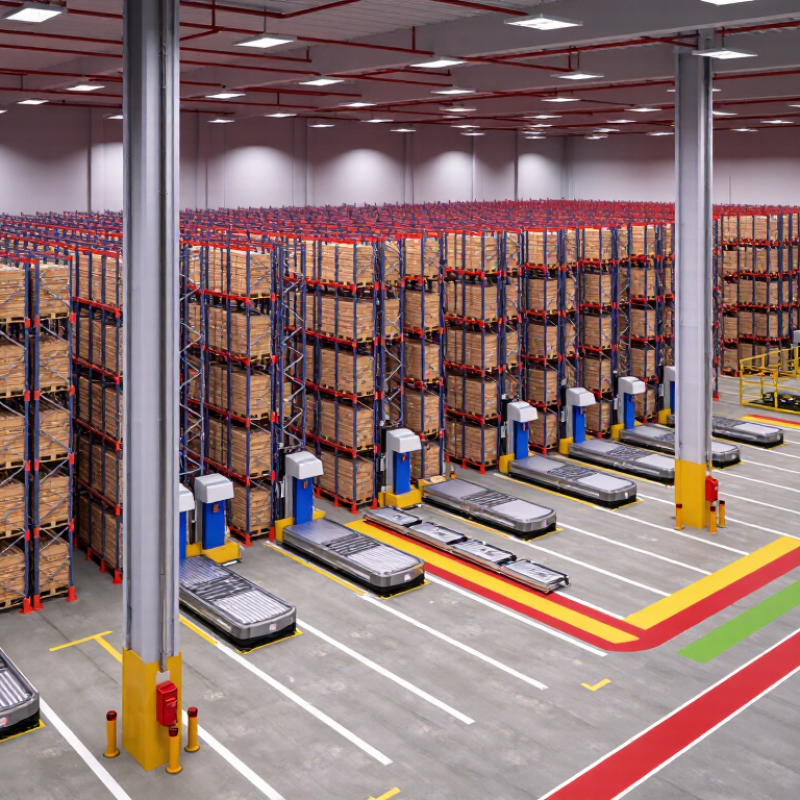
A shuttle racking system moves pallets inside deep storage lanes, rather than sending a forklift down every aisle. In a semi-automated setup, a forklift places a battery-powered shuttle on the lane rails, then sets a pallet onto it. Sensors help the shuttle travel to an open position, lift the load, and place it securely. For retrieval, it brings the selected pallet back to the lane entrance. The forklift still does the loading and collection. That detail matters: a shuttle reduces travel inside lanes, but it does not remove forklift traffic from the whole warehouse.
Lane access determines how stock rotates. A single-access lane generally suits last-in, first-out storage; access from both ends can support first-in, first-out movement. Multi-directional shuttles can travel across lanes or levels when paired with suitable transfer equipment, but add control and maintenance requirements. Small details count. Pallet condition, load stability, rail clearance, and battery charging routines all affect reliable movement. A bent pallet may snag. It happens.
MHI’s 2024 Annual Industry Report found that 55% of surveyed supply-chain professionals planned to increase technology investment over the following two years. That figure reflects broad technology spending, not shuttle-racking performance specifically. It does, however, show why warehouses are assessing automation alongside space and labor constraints. Before choosing a layout, managers should test real pallet dimensions, peak retrieval rates, and replenishment patterns. A dense lane can save floor space, yet poorly matched access rules may leave urgent stock inconveniently buried.
A shuttle rack combines deep storage lanes, support rails, a powered shuttle, and a control system. The rack holds the loads; the shuttle travels beneath pallets and moves them along each lane. A forklift places pallets at the lane entrance, then retrieves them from the same access point. Sensors help detect pallet position and lane conditions. Small details matter. Rail alignment, pallet dimensions, load weight, and battery charging all affect dependable movement.
In a typical process, an operator selects a lane and sends the shuttle in. The cart lifts a pallet, carries it to an open position, and sets it down. For retrieval, it brings the selected pallet back to the entrance. Depending on the operating method, the system can support last-in, first-out or first-in, first-out handling.
MHI and Deloitte’s 2024 Annual Industry Report found that 55% of respondents expect to adopt robotics and automation within five years.
Their 2023 report also found that 74% expected to increase supply-chain technology investment.
These figures support growing interest, not guaranteed savings. A shuttle can reduce forklift travel inside lanes, but poor lane planning still creates congestion.
Not foolproof. Test actual pallet sizes and throughput before fixing the layout.
Shuttle racking systems differ mainly in how their carriers move through storage lanes. A single-direction shuttle travels along one lane, moving pallets between the aisle and the rear of the rack. It suits high-density storage when pallets usually follow a last-in, first-out pattern. An operator sends the shuttle with a handheld control, while a forklift places or retrieves pallets at the lane entrance. Simple, but lane depth matters. Long lanes can reduce aisle use, yet they may slow access to specific pallets.
Four-way shuttle systems can travel both along a lane and across it, allowing one carrier to serve several locations. They can support flexible storage layouts and reduce the need for forklifts to enter rack lanes. Some facilities also use multi-level arrangements, with lifts transferring shuttles or pallets between levels. The added coordination can bring more control, but also more equipment and maintenance points. A common planning mistake is choosing by storage density alone. Pallet dimensions, load consistency, daily throughput, and the required stock rotation all matter. Measure the actual operating pattern before choosing a system; a neat layout on paper may not match a busy shift.
How Shuttle Types Differ in Warehouse Applications
A radio shuttle suits warehouses that store many pallets of the same SKU in deep lanes. A forklift places the unit at the lane entrance, while the shuttle carries pallets to open positions. This reduces forklift travel inside the rack. Many layouts use last-in, first-out access; access from both ends can support first-in, first-out handling. Space matters. The system works best when replenishment and picking plans match the lane sequence.
Four-way shuttles can travel across rack lanes and connect with lifts or transfer points. This flexibility helps facilities handling more SKUs, frequent order changes, or several storage levels. The trade-off is greater coordination: software, lifts, and shuttle traffic must work together. A small delay at a transfer point may affect several lanes. Cold rooms benefit from reduced operator exposure, though battery performance and maintenance access still need attention.
A dense layout can look efficient on a drawing, yet daily pallet variation may undermine it. Check load dimensions, pallet condition, peak throughput, and access needs before choosing a type. One detail is easy to miss: a system designed around ideal pallets may struggle with real ones. Warehouses with steady, high-volume stock often favor deep-lane operation; mixed inventory may justify more flexible movement.
How shuttle types differ across common warehouse applications
Application-fit ratings use a qualitative 1–5 scale, based on system operating characteristics; they are not measured performance benchmarks. Radio shuttles suit dense pallet storage in dedicated lanes, while 4-way and mother-child systems offer more movement flexibility. Actual suitability depends on layout, pallet flow, SKU profile, and throughput requirements.
Start with the inventory, not the equipment brochure. Record pallet dimensions, load weights, and daily movements across several representative weeks. A layout based on average demand may struggle during seasonal peaks. Measure aisle width, beam height, floor flatness, and sprinkler clearances with the site team. Small errors matter.
Choose lane depth and operating logic around how goods move. A last-in, first-out layout usually suits access from one end, while first-in, first-out needs access at both ends. Match these choices to product rotation and dispatch routines. Group compatible pallet sizes in the same lanes; uneven pallets can impede shuttle travel. Check how many distinct stock-keeping units need dedicated lanes, since deep storage can reduce access to individual items.
Configuration also depends on throughput, charging routines, and operator training. Estimate peak pallet moves per hour, then check whether the number of shuttles and charging points can support that workload. Test the assumptions. Confirm that controls provide clear status alerts and that staff can retrieve a stalled unit safely. Pilot one representative lane before committing to a full installation. There is rarely a perfect layout; a small loss in storage density may be worthwhile if it makes replenishment and maintenance easier.
| System Type or Configuration | Pallet Movement and Flow | Typical Use | Key Selection Factors | Configuration Considerations |
|---|---|---|---|---|
| Radio shuttle with LIFO lane configuration | A powered shuttle carries pallets along a storage lane. Loading and retrieval take place from the same end, so the last pallet loaded is generally the first pallet retrieved. | High-density storage for products managed in batches or where strict first-in, first-out rotation is not required. | Number of pallets per SKU, required selectivity, pallet condition, load dimensions, and the need to access individual lanes. | Plan lane depth around batch size and inventory turnover. Allow for compatible pallets, shuttle travel clearance, and safe procedures for lane entry and retrieval. |
| Radio shuttle with FIFO lane configuration | Pallets are loaded at one end of the lane and retrieved from the opposite end. This supports first-in, first-out flow when lane operation and inventory control are managed correctly. | Products requiring age-based rotation, such as dated or time-sensitive stock, when each lane can be assigned to a suitable SKU or lot. | Need for stock rotation, access from both rack faces, SKU and lot discipline, and available aisle space on the loading and retrieval sides. | Provide access aisles at both ends. Confirm that the operating process maintains the intended loading sequence and that lane assignments suit the inventory profile. |
| Four-way shuttle system | Shuttles can travel in more than one horizontal direction and may move between lanes or levels using transfer equipment such as lifts. | Automated, high-density storage where flexible routing and reduced reliance on a dedicated shuttle for every lane are priorities. | Required throughput, number of storage levels, vehicle and transfer capacity, control-system requirements, and the consequences of equipment downtime. | Coordinate rack geometry with shuttle paths, lifts, transfers, charging, and controls. Validate peak-hour pallet movements with a system-level design rather than storage capacity alone. |
| Multi-depth shuttle racking | Multiple pallet positions are arranged behind the aisle within each lane; a shuttle moves pallets through the lane to store or retrieve them. | Warehouses holding multiple pallets of the same SKU or batch, where greater storage density is more important than direct access to every pallet. | SKU concentration, replenishment pattern, inventory rotation rules, retrieval frequency, and the balance between storage density and selectivity. | Keep lane assignments aligned with SKU and batch policies. Check that the chosen lane depth does not create excessive reshuffling or slow access to frequently needed pallets. |
| Shuttle racking integrated with pallet lifts or conveyors | Shuttles handle movement within storage lanes; lifts or conveyors transfer pallets between rack levels or connect storage to other warehouse processes. | Multi-level storage layouts and operations that need a defined interface between racking, picking, receiving, or dispatch areas. | Inbound and outbound peak rates, lift cycle capacity, conveyor accumulation space, pallet orientation, and compatibility with warehouse control processes. | Size transfer equipment for the required flow and consider queues at lift and conveyor interfaces. Define how exceptions, damaged pallets, and equipment stops will be handled. |
| Selection factor: storage profile and inventory rotation | Establish whether stock is managed as FIFO or LIFO and identify how many pallets are typically held per SKU, lot, or batch. | Applies to all shuttle configurations. | Review SKU count, pallet quantity per SKU, expiry or date controls, demand variability, and the frequency of replenishment and retrieval. | Use actual inventory and order history where available. High storage density can reduce direct access, so assess the impact on replenishment and retrieval workflows. |
| Selection factor: pallets, loads, and rack design | Shuttle and rack dimensions must suit the unit loads that will be stored and moved. | Applies to all shuttle configurations. | Verify pallet type, overall load dimensions, weight, overhang, load stability, and the condition and consistency of reusable pallets. | Have a qualified rack designer check the rack, clearances, load ratings, floor conditions, and applicable local requirements before installation or modification. |
| Selection factor: throughput, space, and operations | System capacity depends on the complete flow path, including aisles, shuttles, lifts, conveyors, and operating processes. | Applies to all shuttle configurations. | Measure peak as well as average pallet movements, available building height and floor area, replenishment windows, staffing, and service requirements. | Compare storage capacity with achievable throughput. Include charging or battery management, maintenance access, operator training, safety procedures, and contingency plans. |